Healthcare is evolving rapidly, and patient expectations are
changing with it. Today, patients want quick responses, convenient appointment
booking, and reliable access to clinic information whenever they need it.
However, many clinics and hospitals still depend on reception teams who cannot
answer every call during busy hours, lunch breaks, holidays, or after closing
time.
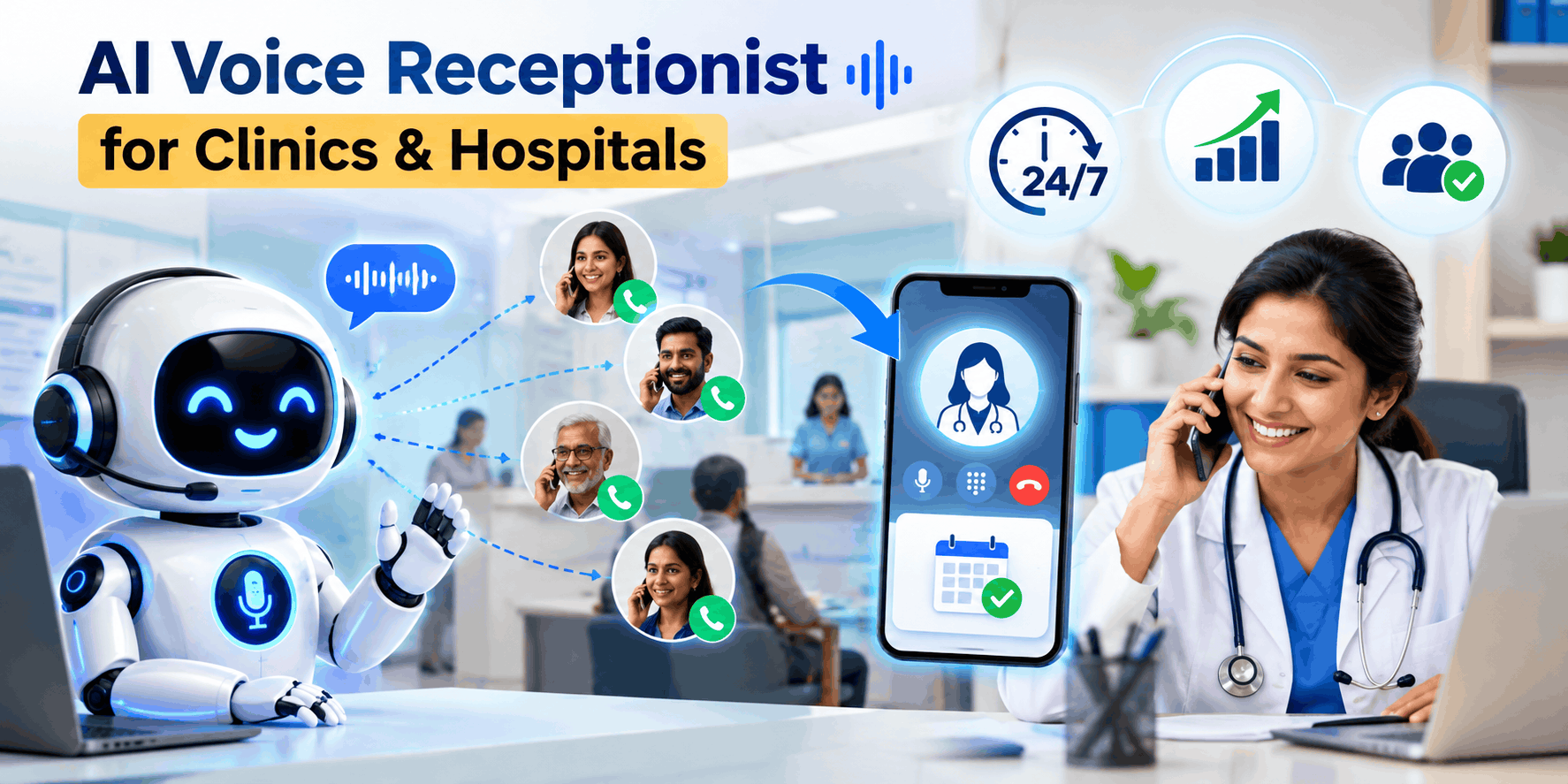
This is where an AI Voice Receptionist in clinics and
hospitals can make an impact. Through automation of phone calls and aiding
in the process of making appointments, AI-based voice technology enables
healthcare organizations to communicate more effectively with their patients
while focusing on actual patient visits.
What Is an AI Voice Receptionist in Healthcare?
An Artificial Intelligence Voice Receptionist is an advanced
voice assistant, which is intelligent enough to answer incoming calls,
comprehend patient requests, and respond to them with the use of information
available from the configured clinics. It may help patients inquire about
consultation timings, availability of doctors, appointments, clinics'
locations, and scheduling methods.
Unlike a conventional voicemail setup, the AI voice agent is
able to join the discussion and lead callers through certain procedures.
For instance, the patient making a call outside regular
office hours might be interested in finding out about their earliest
appointment. The AI receptionist will be able to give out the preconfigured
information and help schedule an appointment, should the proper scheduling
system be connected.
This makes AI call automation for clinics and hospitals
a practical option for improving access to routine administrative support.
Why Are Clinics Adopting AI Voice Receptionists?
1. Provide 24/7 Patient Support
Sometimes, the patients do not make calls within office
hours. A patient who is about to finish his work during the evening could be
interested in scheduling an appointment, whereas another one may be interested
in knowing when the clinic opens the next day.
The conventional receptionist desk usually works within the
specified office hours. However, the AI Voice Receptionist can work around the
clock, depending on how the service is set up.
This means that the clinic would be able to attend to the
standard queries beyond office hours.
2. Reduce Missed Calls During Peak Hours
In the course of hectic OPD hours, the receptionists usually
have to juggle multiple tasks like welcoming patients, dealing with payments,
making appointments, and receiving phone calls.
Since the employees are engaged in their tasks, the calls
can go unattended. The callers may return at a later time or may call another
medical practitioner.
A receptionist in AI for clinics can assist in
managing routine incoming calls and decrease stress on the front desk. Based on
its capacity, it may even take care of multiple conversations at the same time.
For the owners of clinics, analyzing the missed call trends
and pinpointing commonly unattended queries can prove to be quite beneficial.
3. Simplify Patient Appointment Booking
The task of scheduling is among the most repetitive ones in
administration within healthcare. Often enough, patients will contact the
clinic in order to schedule appointments, see availability, confirm them, or
reschedule.
An AI Voice Receptionist linked to an appropriate
appointment management system can assist patients in all these procedures
without having to get everyone handled personally by staff.
A typical workflow may include:
- Understanding
the patient's appointment request.
- Checking
available slots through an approved scheduling integration.
- Collecting
the necessary booking information.
- Confirming
the appointment details.
- Directing
requests that require human assistance to the appropriate staff member.
The automated booking should at all times align with the
real schedule and appointment validation policies of the clinic.
4. Improve Patient Experience with Faster Responses
Long wait times and unanswered calls could be making access
to healthcare services quite challenging. This might just involve providing
information on consultation times, booking appointments, and the documents
needed.
An AI-driven healthcare receptionist can help provide
consistent answers to repetitive administrative questions based on information
approved by the clinic.
The speed at which information can be accessed ensures that
patients know what needs to happen next without going through the motions of
communication.
On the other hand, AI should assist rather than replace the
human element when it comes to empathic decision-making.
5. Reduce Administrative Workload for Reception Staff
Receptionists play an important role in their organization,
but making repeated calls via the phone occupies a considerable amount of their
time.
An AI Voice Receptionist can help to deal with simple things
like responding to general queries, passing clinic information, and helping
with appointments.
This will provide enough time for receptionists to focus on
patients coming to their clinic and complicated inquiries.
The objective is not simply to automate calls. It is to
create a more manageable workflow in which technology handles suitable routine
tasks and people remain available for tasks that need human judgement.
6. Support Patient Communication After Hours, on
Weekends, and During Holidays
The clinics may get appointment inquiries despite the
physical reception of the clinics being closed.
Weekend, holiday, or unannounced absence of staff members
can lead to a break in communication processes.
With the help of AI call automation available all day and
night, the healthcare organization can provide access to the required
administrative data beyond the working hours.
In the case of making a call during the weekend, for
instance, one may find out about the working schedule of the clinic.
The exact service depends on the AI platform, available
integrations, and the clinic's operating policies.
7. Maintain More Consistent Communication
Human receptionists may communicate somewhat different
information when there are many calls to attend, especially when the schedule
or policy of the clinic changes frequently.
The AI Voice Receptionist can draw information from
an authorized source to provide consistent answers to typical queries. In cases
when clinic timings, doctor’s schedules, or booking policies get changed, the
corresponding information needs to be entered into the system.
Consistency is especially important for clinics having more
than one doctor.
For complex questions, complaints, or requests outside the
configured knowledge base, the system should offer an appropriate route to
human assistance.
Key Features to Look for in an AI Voice Receptionist
Before adopting an AI receptionist, clinics should evaluate
whether the solution supports their actual workflow.
Important features include:
- 24/7
call answering: Handles routine calls beyond regular reception hours.
- AI-powered
conversations: Understands common requests and responds naturally.
- Appointment
booking support: Assists with scheduling when compatible integrations
are available.
- Appointment
confirmations and reminders: Supports configured communication
workflows.
- Rescheduling
assistance: Helps patients request appointment changes.
- Clinic
information management: Provides approved details about timings,
locations, and procedures.
- Human
call escalation: Routes complex or sensitive enquiries to the
appropriate staff member.
- Privacy
and security controls: Ensures confidentiality of the patients'
information by means of access control and other security measures.
Clinics should verify which features are included in their
chosen solution rather than assuming every AI receptionist offers the same
capabilities.
Is an AI Voice Receptionist Safe for Patient
Communication?
Patient communications require great care because such
discussions can have confidential information as well as urgent medical issues.
The AI receptionist should function under very clear
guidelines. This should give out information only where it is allowed, but
should not make any diagnosis of any medical condition or prescribe medicines
or be substitute to a certified health professional.
Escalation policies need to be in place for any emergency,
clinical queries, upset callers and those who wish to talk to a human.
Before implementation, evaluate data protection practices,
consent requirements, call recording policies, access permissions, and
applicable healthcare regulations.
A responsible deployment combines automation with
appropriate human oversight.
How Tatkal Doctor Helps Clinics Modernise Patient
Communication
Tatkal Doctor is an AI-based automation system in the field
of healthcare aimed at improving interaction and appointment management for
hospitals and clinics.
The AI Voice Receptionist feature allows automating patient
calls, whereas the WhatsApp appointment booking function helps the patients
interact with the clinic regarding appointments via messengers.
Tatkal Doctor, through its reduction of administrative
procedures, assists health care providers in identifying more effective methods
for handling queries and appointments.
The clinics need to analyze their call volumes, patient
requirements, and scheduling process to see how they will fit the capability.
How to Choose the Right AI Voice Receptionist for Your
Clinic
Selecting the right solution begins with understanding your
clinic's communication challenges.
Consider these questions before implementation:
- How
many patient calls does your clinic receive each day?
- During
which hours are calls most frequently missed?
- Which
enquiries are repeated most often?
- Does
your appointment system support integration with the AI solution?
- Can
the system transfer complex calls to human staff?
- What
privacy, security, and compliance safeguards are available?
- Can
you measure changes in answered calls, booking completion, and staff
workload?
Start with standard and relatively risk-free administration
duties and then evaluate the performance prior to moving on to automate other
processes.
Examples of useful performance indicators include answering
rates, appointments made, transferring rates, customer satisfaction ratings,
and the number of inquiries that require human intervention.
AI Voice Receptionists have been used in clinics due to the
increasing need for more than just conventional methods of communicating with
patients. In addition to answering calls outside office hours, scheduling
appointments, and reducing redundant administrative tasks, AI voice technology
provides the best possible solution for communication issues in healthcare.
The success of the system lies in choosing the right
feature, keeping information about the clinics accurate, making sure the
patient data is secure, and always having human support available in case of
need.
When it comes to clinics and hospitals wishing to bring
their patient communication into the modern age, one way would be to employ the
help of an AI Voice Receptionist. With services like Tatkal Doctor, healthcare
providers have the opportunity to try AI automation via voice and WhatsApp.